Why Every SaaS Needs SSO, SAML, and SCIM: The Blueprint for Secure, Scalable User Management in 2025
A quick guide to SSO, SAML, and SCIM, what they are, how they work, and why every SaaS platform needs them for secure, seamless logins and user management.
1. SSO (Single Sign-On)
What is it?
Single Sign-On is an authentication process allowing users to log in once and gain access to multiple applications without re-entering credentials for each app.
How does it work?
User logs in via a central identity provider (like Azure AD, Google Workspace, Okta); all connected apps trust that identity and allow access.
Tech protocols used:
SAML, OAuth, OpenID Connect—SSO is the experience, these are the protocols.
Benefit for SaaS:
Frictionless user experience across your app suite
One login = access to all SaaS products/services
Reduces password fatigue and IT support tickets
Improves security by centralizing authentication
2. SAML (Security Assertion Markup Language)
What is it?
SAML is an open standard protocol used for exchanging authentication and authorization data between identity providers and service providers.
How does it work?
When users try to access a SaaS app, SAML facilitates a secure, XML-based authentication handshake between the app and their company’s ID system (e.g., Okta, Azure AD).
Benefit for SaaS:
Enables enterprise SSO (especially popular with larger organizations)
Secure, non-password authentication using signed assertions
Standard for integration with corporate identity infrastructure
3. SCIM (System for Cross-domain Identity Management)
What is it?
SCIM is a protocol for automated user provisioning and management—think “user sync” not “login.”
How does it work?
Automatically creates, updates, disables, or deletes user accounts in a SaaS tool based on changes made in the central directory (HR system, AD, etc.).
Benefit for SaaS:
Effortlessly onboard and offboard users at scale (HR, IT)
Keeps user roles and profiles up to date (no manual spreadsheet work)
Prevents security issues from “ghost” or orphaned accounts
Why do SaaS tools need SSO, SAML, SCIM?
Enterprise demand: Companies expect easy integration with their central identity providers for both login (SSO/SAML) and automated user management (SCIM).
Security: Minimizes password risk, centralizes security controls, instantly disables access for offboarded users.
Efficiency & Scale: Reduces IT workload, enables instant onboarding/offboarding, supports compliance (GDPR, SOC2, etc).
Competitive Advantage: Many companies won’t buy SaaS that can’t support SSO/SAML/SCIM, corporate IT requires it.
Summary Table:
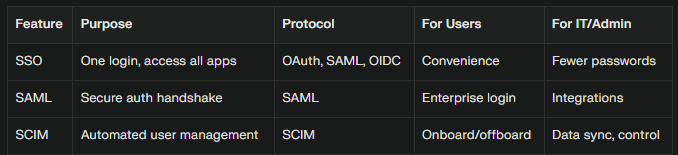
For SaaS, supporting SSO (via SAML/OAuth/OIDC) and SCIM is no longer optional, it’s essential for business growth, security, and customer trust.